LYRIQ Insight · AI Governance
AI Model Drift Detection Catches Decay Early
Drift rarely announces itself — AI agents keep answering confidently while quietly getting worse. This article argues that the operational metrics your QA team already collects, read as trend lines, catch decay weeks before a client ever complains.
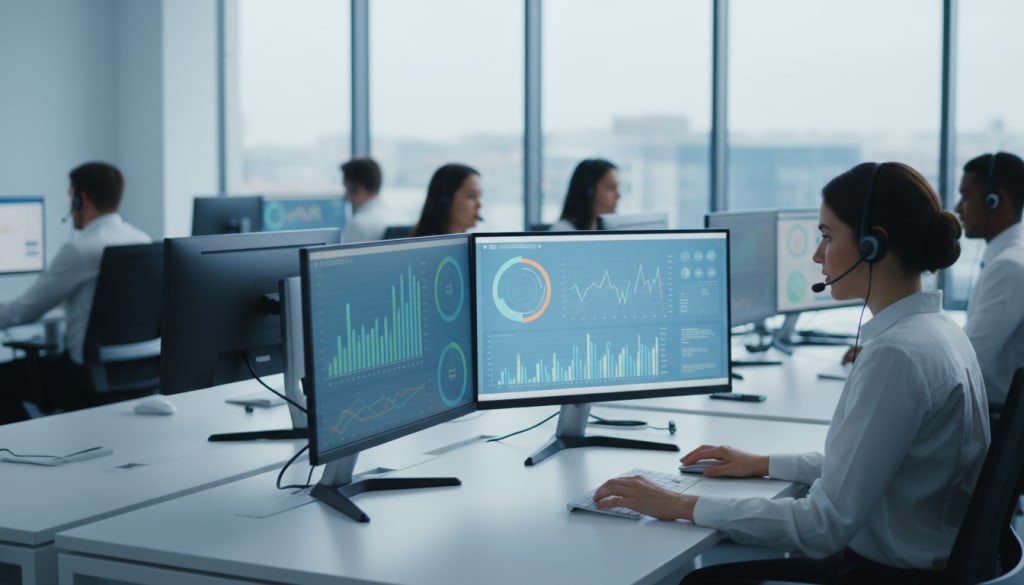
If you run QA or delivery for a contact center, you already know the quiet fear: the AI agents that passed every test at go-live are slowly getting worse, and nobody will notice until a client escalates. That is exactly the problem AI model drift detection is meant to solve — not with a science project, but with the operational metrics you're already collecting. The uncomfortable truth is that drift almost never announces itself. It leaks out one slightly-wrong answer at a time until a pattern becomes a complaint.
The good news for operators: drift is predictable. It leaves fingerprints in your day-to-day numbers long before it reaches a client's inbox. You just have to know which signals to watch and how to read them.
The argument
"We won't know until clients complain" — why that's the real risk
Most teams treat client complaints as their drift alarm. It's the loudest signal, so it feels like the reliable one. But by the time a client complains, the damage is already booked: a bad interaction happened, a customer was frustrated, and your delivery lead is now on a call explaining what went wrong. Complaints are a lagging indicator. They tell you drift happened weeks ago.
The reason this objection persists is that drift in a language model is subtle. The AI doesn't crash. It doesn't return an error. It keeps answering confidently — it just starts answering slightly worse. It misclassifies an intent it used to nail. It stops offering a workaround it used to suggest. It hedges where it used to resolve. None of that trips a system alert. But all of it shows up in your operational metrics if you're looking.
That's the reframe this whole post is built on: operational metrics reveal drift early. You don't need a separate data-science stack to see it coming. You need to treat the numbers your QA function already touches as a monitoring system.
The operational signals that predict AI model drift detection
Effective machine learning model monitoring in a contact center doesn't start with model internals — it starts with behavior you can observe from the outside. These are the leading signals that move before CSAT does:
- Containment and deflection rate: A gradual drop in how many conversations the AI resolves without a human is often the first fingerprint of drift. The AI is escalating more because it's less sure — or less right.
- Escalation and handoff reasons: Don't just count handoffs; tag why they happen. A rising share of "AI gave wrong info" or "AI misunderstood" handoffs is drift you can see in real time.
- Intent classification confidence and distribution: When the mix of detected intents shifts without a matching change in customer contact reasons, the model is drifting, not the customers.
- Response consistency: Ask the same set of known questions on a schedule. Answers that change for no legitimate reason are a clean drift signal.
- Rework and reopen rates: Tickets the AI "resolved" that get reopened are a direct measure of quality decay — and they move earlier than survey scores.
None of these require you to crack open the model. They're all AI performance degradation monitoring done with data your operation already produces. The skill is watching the trend line, not the single day.
Continue readingShow less
Turning signals into ML drift prevention strategies
Measuring drift is only useful if it changes what you do. The strongest ML drift prevention strategies connect each signal to a threshold and an owner, so a moving number becomes an action instead of a note in a dashboard nobody reads.
Start with baselines. For every signal above, capture what "healthy" looked like in the two weeks after your last validated release. That baseline is your reference point — drift is defined against it, not against gut feel. Then set alert bands: a small deviation is noise, a sustained deviation over several days is a signal, and a sharp break is an incident.
The other half is continuous model validation techniques — small, repeatable checks that run whether or not anything looks wrong. A weekly golden-set replay (a fixed batch of representative interactions scored against known-good answers) will catch drift that aggregate metrics can average away. Sampling live conversations for human QA review, weighted toward the intents where confidence dropped, does the same from the other direction. Platforms built for support operations, including LYRIQ, can automate this scoring so QA reviews the exceptions instead of grading everything by hand.
Drift you measure is drift you can manage. Drift you wait to hear about is drift that already cost you a customer.
Reading the signals together, not in isolation
One metric moving is rarely proof of drift — noise happens. The point of good AI model drift detection is correlation. When containment dips, "wrong info" handoffs rise, and reopen rates tick up in the same window, that's not three coincidences. That's a pattern pointing at the same root cause, usually days or weeks before it reaches a survey or a client review.
This is also why QA and delivery are the right owners for drift, not just engineering. You sit on the operational data. You already read handoff reasons and reopen tickets. Framing those as an early-warning system — rather than a monthly report — is the shift that turns "we won't know until clients complain" into "we saw it Tuesday and corrected it by Friday."
What to do next
Your next step: a Drift Monitoring Dashboard Spec
You don't need a new tool to start. You need a written spec for what your team will watch. Think of it as a Drift Monitoring Dashboard Spec: a one-page definition of the signals that matter for your operation, the healthy baseline for each, the alert bands that separate noise from a real move, and the owner who acts when a band is crossed.
Draft it as a working document, not a purchase. List your leading signals — containment, handoff reasons, intent distribution, response consistency, reopen rate. Next to each, write its baseline, its thresholds, its review cadence, and who responds. That single page converts drift from something you fear into something you monitor. When you're ready to put continuous monitoring and automated QA behind that spec, book a demo with LYRIQ.